
Our Projects
Our company participates in the LIFE UpcyclingGrass project:
Pilot project on technological solutions for sustainable and climate-friendly management of grassland biomass
(101114335 - LIFE22-CCM-LV-LIFE UpcyclingGrass)
Project objective: to develop, test and demonstrate various innovative technological approaches for climate-smart grassland management and the sustainable use of grassland biomass, for the production and use of sustainable and economically competitive agricultural products in livestock, crops, horticulture and forestry.
Project duration: 1.09.2023 - 31.08.2028
The project is being implemented:
- Latvian Fund for Nature
- SIA Sita Nature Park
- SIA Bioefekts
- Association "Baltic Coasts"
- Latvian State Forest Research Institute "Silava"
Funded by:
- European Union LIFE programme
- Ministry for Smart Administration and Regional Development
Vairāk informācijas: https://upcyclinggrass.ldf.lv

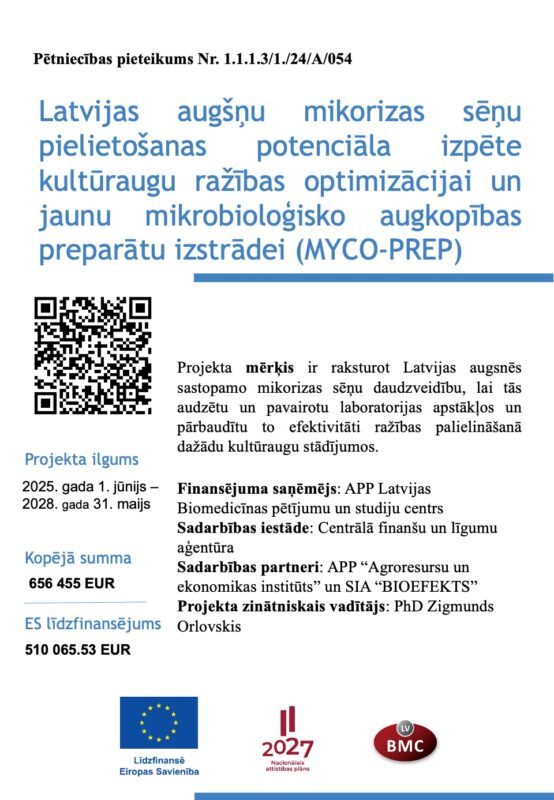
Projekta nosaukums: Latvijas augšņu mikorizas sēņu pielietošanas potenciāla izpēte kultūraugu ražības optimizācijai un jaunu mikrobioloģisko augkopības preparātu izstrādei (MYCO-PREP)
Project identification No: 1.1.1.3/1./24/A/054
Project duration: 1 June 2025 - 31 May 2028
Total project funding: €656 455
Scientific supervisor of the project. Dr. Zigmunds Orlovskis
Project cooperation partners: the Institute of Agroresources and Economics and BIOEFEKTS
Innovative agricultural technologies are the cornerstone for increasing productivity and competitiveness. This includes a set of integrated and sustainable practices to increase crop productivity by reducing the use of imported synthetic fertilisers and pesticides and replacing them with alternative means. Soil beneficial micro-organisms are the basis for the development of such products. Mycorrhiza is a beneficial relationship between plant roots and soil fungi that helps plants to absorb water and minerals and additionally protects against pests and diseases. Mycorrhiza is beginning to find a growing market niche in the world in the form of commercial crop protection products, but is not yet represented by locally sourced and proven effective mycorrhizal fungi products.
We have combined the strong scientific expertise and input in mycorrhizal research of Dr. Soon-Jae Lee, a foreign consultant at the University of Lausanne, Switzerland, and the Plant-Microbe Interactions Research Group of Dr. Z. Orlovskis (BMC), as well as specialists in microbiological preparations production (Bioefekts Ltd.) and crop production technology research (AREI) to identify the mycorrhizal diversity of Latvian soils and to determine the effect of mycorrhizal preparations on cereal, legume, herb and tuber crop yields in vegetation tray trials.
Aim: To characterise the diversity of mycorrhizal fungi in Latvian soils, to grow and propagate them under laboratory conditions, and to test their effectiveness in increasing productivity in different crop plantations.
Main project activities and objectives:
- Soil sampling and isolation of mycorrhizal fungi: collect soil samples from different agricultural regions of Latvia and isolate mycorrhizal spores using soil fractionation and density gradient columns.
- Mycorrhizal identification and community characterisation: extraction of fungal DNA from environmental and spore samples to determine mycorrhizal community structure and diversity using molecular ITS sequencing techniques.
- Mycorrhizal cultivation: in vitro cultivation in the laboratory using a carrot hairy root system to establish a collection of Latvian mycorrhizal fungi for further functional experiments in the laboratory and for Greenhouses.
- Evaluation of isolates for crop optimisation: to test the yield enhancing properties of newly isolated mycorrhizal fungi and compare them with the effects of commercially available products containing plant growth promoting bacteria or fungi under different fertilisation intensity conditions.
Expected results of the project:
- Science and the Latvian Mycorrhizal Collection - characterising the hitherto unexplored diversity of mycorrhizas. The MYCO-PREP project will significantly contribute to the characterisation of the diversity of endemic mycorrhizal fungi in Latvia and will test an innovative methodology for their laboratory cultivation in carrot hairy roots. This methodology has been successfully applied in the past to joint projects of Dr Soon-Jae Lee and Dr Orlovski's research groups. The project is expected to result in an unprecedented collection of mycorrhizal cultures in Latvia, which will be included in the databases of international organisations.
- Prototypes of mycorrhizal formulations for crop growth promotion. By evaluating the effect of mycorrhizal species isolated in Latvia on the productivity of different crops (winter wheat, leek, pea and potato) in comparison with microbial biostimulants (B. subtilis and Trichoderma spp.) produced by commercial partner SIA Bioefekts under different fertilisation conditions, it will be possible to create prototypes of new crop production products with plant species-specific characteristics.
The project will promote knowledge transfer and innovation in crop production by generating new insights for different crops. The expected outcome of the research is a prototype (new technology) of a new locally produced mycorrhizal fungi formulation for further research on its production, thus promoting cooperation between sectors and the production of competitive local raw materials for the Latvian and Northern European markets. The results are to be published in the form of a scientific article and made available to the public and industry professionals through outreach events, conferences and digital materials. The scientific data generated by the project will serve as a basis for an informed transformation of agricultural soil and crop management practices (new methods), reducing the use of synthetic imported fertilisers and pesticides and increasing the use of locally sourced and produced microbiological preparations, thus fundamentally changing the conventional production methodology and the traditional import-export structure of the agricultural sector in this sector of the economy. The main objective of the project is thus in line with RIS3 priority 1 - more efficient production of primary products with higher added value through the use of locally produced microbiological preparations and reduction of opportunity costs by reducing imported inputs.
Information published 02.06.2025.

Project progress:
1 June 2025 - 31 August 2025
Coordination of the project activities has been initiated between the project partners - the Latvian Biomedical Research and Study Centre, the Agroresources and Economics Institute (AREI) and the crop protection products manufacturer SIA Bioefekts. The first field samples were collected for the isolation of new mycorrhizae from Latvian agricultural soils. The protocol for isolation of mycorrhizal spores, morphological identification of microorganisms and collection of pure cultures was optimised. Collection of soil chemical and physical properties of the sampling sites and recording of metadata for the next steps of the project initiated.
Information published on 31.08.2025.
Project progress:
2025. 1 September 2025 - 30 November 2025
During this quarter, Bioefekts Ltd prepared the infrastructure of the MYCO-PREP project by adapting the facilities and equipment for further cultivation of mycorrhizal isolates. Cooperation with BMC and AREI continued on sample handling and spore morphological identification procedures, as well as refinement of the methodology for obtaining pure cultures. The technical basis for future experimental activities of the project was prepared.
Information published on 30.11.2025
Information published 28.02.2026.


